
Salesforce Agentforce Transformation: A Strategic Guide to Winning the Agentic Era
Can an AI agent truly handle high-stakes enterprise workflows without human intervention? While the early days of chatbots were marked by limited scripts and frequent escalations, we are entering a new epoch where autonomous agents are delivering measurable business value. Early adopters like Wiley have already seen a 40% increase in case resolution, while Falabella is resolving 60% of WhatsApp inquiries autonomously. However, as many CTOs have discovered, there is a significant gap between an impressive LLM demo and a production-grade enterprise system.
The recent Salesforce Agentforce Transformation signals a fundamental shift in how businesses build, deploy, and govern AI. Salesforce has moved beyond the "model-first" approach to a "system-first" architecture, recognizing that raw intelligence is insufficient without control and precision. This transformation introduces three core pillars: Hybrid Reasoning, Agent Script, and the new Agentforce Builder. For IT leaders and business decision-makers, understanding this evolution is critical to moving from AI experimentation to scalable, high-ROI operations.
In this comprehensive guide, we will explore why Salesforce is re-engineering its AI foundation and what these changes mean for your organization’s digital strategy. From the technical nuances of hybrid reasoning to the practicalities of version-controlled agent scripts, this article covers everything you need to know about the next generation of Salesforce Agentforce Transformation.
The Shift Toward Salesforce Agentforce Transformation: Why Models Alone Fail
For the past two years, the industry has focused almost exclusively on the capabilities of Large Language Models (LLMs). While models like GPT-4 and Claude are technological marvels, they are not, by themselves, enterprise-ready solutions. The Salesforce Agentforce Transformation addresses the reality that LLMs can be "confidently wrong," unpredictable, and difficult to audit in high-stakes environments. When a customer inquiry involves complex billing or medical data, "reasonable judgment" isn't enough; the system requires absolute accuracy.
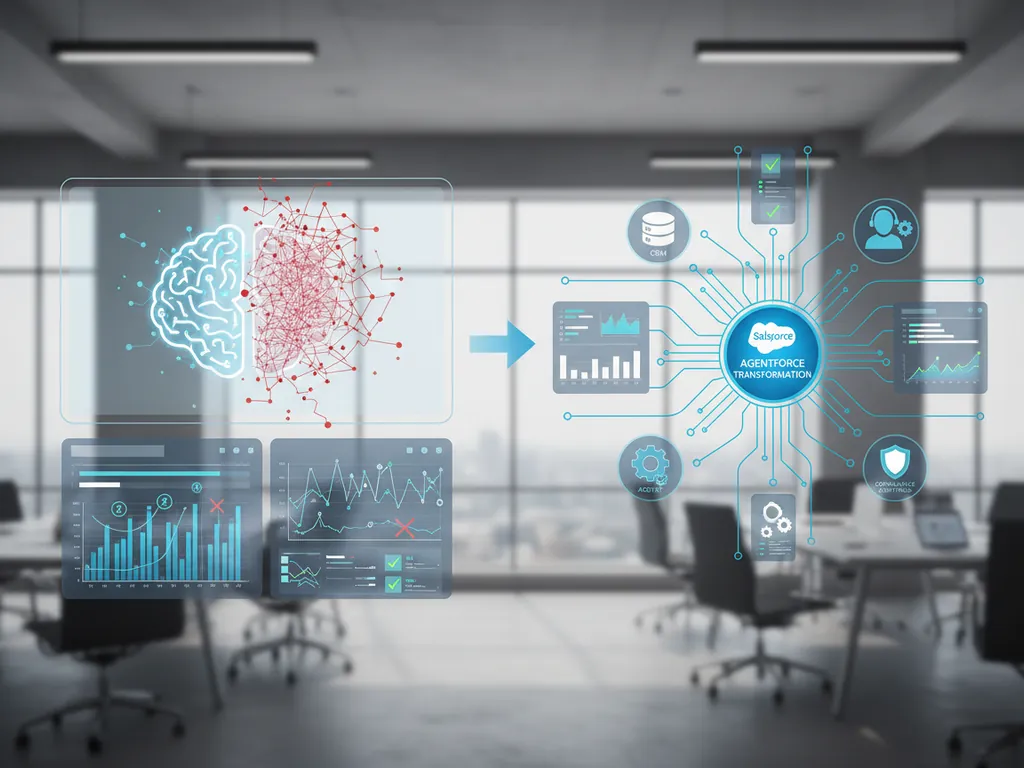
Enterprises are finding that the "intelligence" of an agent is only as good as the "guardrails" surrounding it. This is why Salesforce is pivoting toward a system that blends generative creativity with deterministic business rules. By transforming the foundation of Agentforce, Salesforce is providing the tools to bridge the gap between a chatbot that talks and an agent that executes. This shift ensures that AI becomes a reliable extension of your workforce rather than a liability.
"Real ROI requires systems that blend rules and reasoning so agents behave reliably when stakes are high. Intelligence alone doesn’t deliver enterprise value; reliability does."
This transformation is particularly relevant for users of Service Cloud and Sales Cloud, where the cost of a mistake can lead to customer churn or compliance violations. By moving toward a more structured architecture, Salesforce ensures that agents can operate in "the deep end" of complex business logic without the constant need for human hand-offs.
Mastering Control with Salesforce Agentforce Hybrid Reasoning
The centerpiece of the Salesforce Agentforce Transformation is a concept known as Hybrid Reasoning. Traditional AI agents often rely solely on the LLM to decide the next step in a conversation. While this allows for natural-sounding dialogue, it lacks the rigor required for enterprise workflows. Hybrid Reasoning changes the game by allowing builders to steer the agent’s logic through predefined steps, variables, and constraints.

Think of Hybrid Reasoning as a GPS for AI. While the LLM provides the "engine" to navigate the nuances of human language, the Hybrid Reasoning system provides the "map" and "traffic laws." This allows the agent to:
- Maintain Context: Keep track of complex customer histories across multiple touchpoints in Data Cloud.
- Enforce Compliance: Ensure that the agent never deviates from legal or brand-specific requirements.
- Optimize Execution: Select the most efficient tool or API call based on the specific intent of the user.
For a Salesforce consultant, this means we can now build agents that handle sensitive tasks—such as processing a refund or updating a contract—with the same level of trust as a human employee. By controlling what the agent knows and what it is allowed to decide at every step, businesses can finally deploy Einstein AI capabilities into mission-critical workflows with total confidence.
The Rise of Salesforce Agent Script: Files as the New Foundation
One of the most significant technical shifts in the Salesforce Agentforce Transformation is the move toward "Agent Script." In the past, configuring a bot often felt like an exercise in environment-bound clicks and menus. Salesforce is now embracing the philosophy that "files are where work gets done." By treating agent behavior as a portable, versioned text artifact, Salesforce is aligning AI development with modern software engineering practices.

Why does this matter for your IT team? Salesforce Agent Script allows for:
- Version Control: Track every change to an agent's logic, allowing for easy rollbacks and audits.
- Portability: Move agent configurations seamlessly between sandboxes and production environments.
- Collaboration: Humans and AI can work together on the same "script," making it easier to inspect and govern behavior.
This transition to a file-based approach ensures that Salesforce Agentforce is not a "black box." Instead, it is a transparent, testable, and packageable asset. For organizations with strict DevOps pipelines, this is a massive leap forward, as it allows AI agents to be integrated into existing CI/CD workflows, ensuring that every deployment is stable and predictable.
Efficiency Through the New Salesforce Agentforce Builder
The Salesforce Agentforce Transformation also introduces a revamped Builder experience. The mantra here is simple: "Writing is the new building." Salesforce has recognized that text is the most durable way to express complex intent. The new Agentforce Builder centers the experience around writing and iterating, with AI acting as a first-class participant in the development process.
Rather than starting from a blank canvas, builders can use AI to draft, test, and debug agent logic in real-time. This reduces the "time-to-value" for new AI initiatives. For instance, a Sales Cloud administrator can describe a new lead-qualification workflow in natural language, and the Builder will help generate the underlying Salesforce Agent Script to execute it. This democratization of AI building allows business analysts and developers to collaborate more effectively, ensuring that the AI truly reflects the needs of the business.
Moreover, the integration with Data Cloud means that the Builder can pull in real-time telemetry to show exactly how an agent is performing. This feedback loop is essential for continuous improvement, allowing teams to identify where an agent might be stalling and iterate on the script within minutes rather than weeks.
Expert Perspective: Navigating the Salesforce Agentforce Transformation
At CodeSierra, our certified Salesforce architects and engineers have spent years helping enterprises bridge the gap between legacy systems and modern AI. We've observed that the most successful implementations aren't those with the most complex models, but those with the most robust architectures. The Salesforce Agentforce Transformation validates our long-standing approach: treat AI as a core part of your software stack, not a bolt-on accessory.
Our team has guided clients through the transition from basic Einstein Bots to sophisticated, agentic systems. We've seen firsthand how Hybrid Reasoning can reduce hallucination rates by over 90% in customer service scenarios. By leveraging these new tools, we help our clients build "agentic" organizations where AI handles the routine, allowing human talent to focus on high-value strategy and relationship building. The key is not just to adopt the technology, but to architect it for scale and governance from day one.
Frequently Asked Questions
What is the Salesforce Agentforce Transformation?
It is a fundamental re-architecture of Salesforce’s AI platform, moving from simple LLM-based interactions to a "Hybrid Reasoning" system. It introduces new tools like Agent Script and an enhanced Agentforce Builder to give enterprises more control, precision, and scalability when deploying autonomous agents across their organization.
How does Hybrid Reasoning improve AI accuracy?
Hybrid Reasoning combines the natural language capabilities of LLMs with deterministic business rules and structured steps. This ensures that the agent follows specific guardrails and logic, preventing hallucinations and ensuring that high-stakes tasks are executed correctly every time, rather than relying on the model's "best guess."
Is Salesforce Agent Script difficult for non-developers?
While Agent Script is a file-based, code-like artifact, the new Agentforce Builder is designed to make it accessible. It uses a "writing is building" philosophy where AI assists in drafting and debugging the scripts. This allows both developers and business analysts to collaborate on agent behavior without needing deep coding expertise.
How does this transformation impact existing Salesforce users?
Users of Service Cloud, Sales Cloud, and Data Cloud will find it easier to build agents that actually "do work." The transformation reduces the complexity of integrating AI with existing data and workflows, leading to faster deployment times and higher ROI through better autonomous resolution of customer and sales tasks.
What This Means for Your Business
The Salesforce Agentforce Transformation is not just a technical update; it is a strategic shift that lowers the barrier to entry for true enterprise AI. For business leaders, this means you can finally move past the "pilot purgatory" and start deploying agents that deliver real bottom-line impact. To stay competitive in this agentic era, your business should focus on three immediate actions:
- Audit Your Data: Ensure your Data Cloud is structured to provide the necessary context for hybrid reasoning.
- Identify High-Value Workflows: Look for repetitive, high-volume tasks in Service Cloud that are currently bottlenecked by human intervention.
- Embrace "Files-as-Code": Prepare your IT teams to manage AI agents using the same version-control rigor they use for software.
As Salesforce continues to innovate, the organizations that succeed will be those that view AI as a structured system rather than a standalone miracle. By adopting these new tools now, you position your company to lead the next wave of digital transformation.
How CodeSierra Can Help
Navigating the Salesforce Agentforce Transformation requires a partner who understands the intersection of AI reasoning and enterprise architecture. CodeSierra Tech Private Limited’s team of certified Salesforce architects and engineers specializes in turning complex AI capabilities into scalable business solutions. Our proven approach—rooted in rigorous requirements discovery, robust architectural design, and on-time delivery—ensures your AI agents are reliable, governed, and ready for production. Whether you are looking to implement Hybrid Reasoning or optimize your Data Cloud foundation, we provide the expertise needed to minimize risk and maximize ROI. Ready to get started? Contact us for a free consultation.
Source: This article was curated from Salesforce and enriched with expert insights from CodeSierra Tech Private Limited.